International Health Tourism Authorization Certificate
AK-1584 · 02.02.2026

Dental treatments
Bone operations: general information on suitability, options, stages, risks and questions to discuss with a clinician.
Get in touch ↗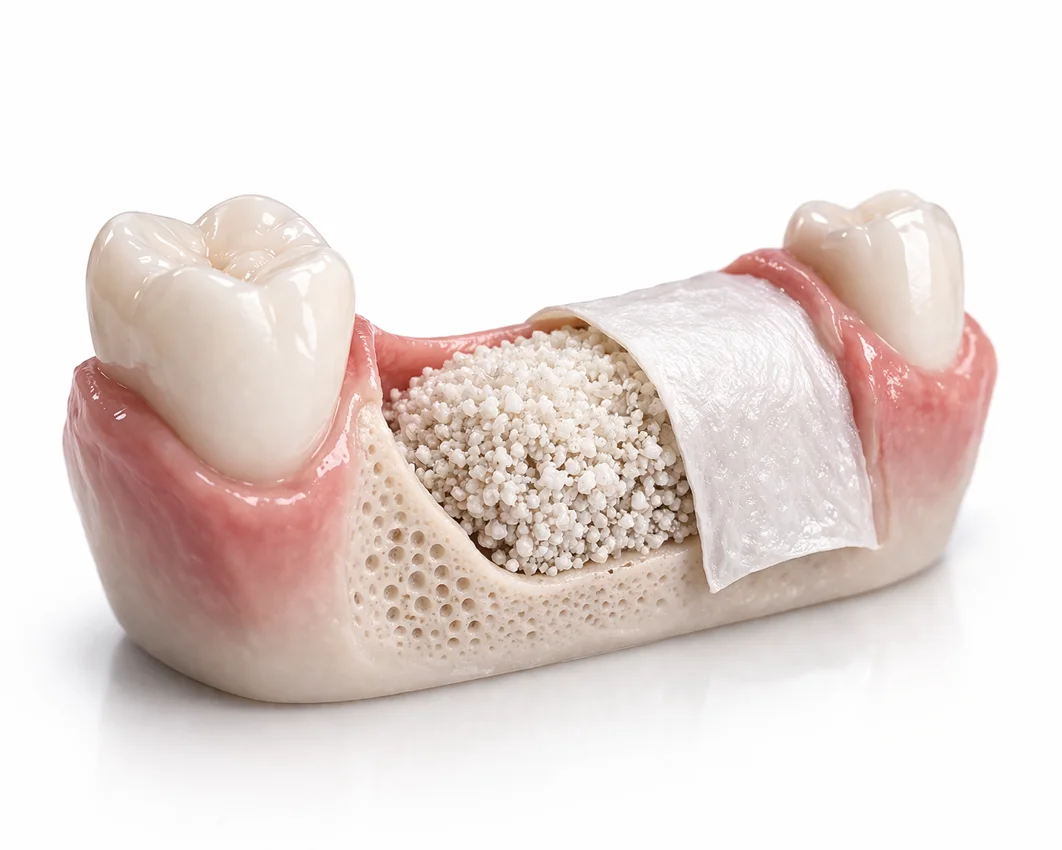
About this treatment
A combined implant and crown treatment completely renews the smile.
It is an ideal solution for patients whose front teeth are preserved but whose back teeth are missing or damaged.
By planning implants and crowns together, the aim is to preserve natural teeth as much as possible and restore chewing function and aesthetics.
Comprehensive implant and crown rehabilitation with diagnostics to evaluate whether bone augmentation is really required.
In some cases, bone grafting is genuinely necessary.
However, alternatives without grafting are also possible in many cases.
🔍 As part of this package, we:
• Carry out detailed diagnostics (CT).
• Assess bone volume and condition.
• Clarify whether grafting is really needed.
📋 After diagnosis, you receive:
• A clear, understandable treatment plan.
• Multiple options, with and without grafting.
• Doctor's recommendations based entirely on your clinical situation.
🦴 Depending on the indication, we offer:
• Bone augmentation procedures (sinus lift, bone grafting).
• Or alternative implant protocols that do not require grafting.
If you have concerns about bone deficiency or a doctor has ever told you that bone grafting is required, this package is for you.
In some cases, bone grafting is truly necessary.
But in many situations, alternative methods allow treatment without grafting.
🔍 Within this package we:
• Perform full diagnostics (CT)
• Assess bone volume and quality
• Determine whether augmentation is truly needed
A clinician assesses whether this approach is suitable and what benefit may be expected. Results vary between individuals; a particular appearance, level of success or duration of effect cannot be promised.
• A clear and understandable treatment plan
• Several solution options (with and without grafting)
• Doctor recommendations based on your specific case
🦴 Depending on indications, we offer:
• Bone augmentation (sinus lift, bone grafting)
• Or alternative implant methods without augmentation
Medtori coordinates communication and the referral of your request to the relevant clinician. The clinician provides the preliminary assessment; the final treatment plan follows an examination and any necessary tests.
Accommodation, transfers and other coordination services are explained in the individual service plan. Medtori provides 24/7 communication and interpreting support.
The treating clinician monitors healing and clinical follow-up. Medtori coordinates communication and interpreting support throughout this process.
After tooth loss, bone gradually decreases: height and width drop, density declines, and implant placement becomes more complex.
Procedure, recovery, stay and follow-up times vary by person and treatment plan. An individual schedule is prepared after clinical assessment; additional visits or changes may be needed.
Changes generally become noticeable within 6–12 months.
Concept: first bone augmentation is performed; after healing, an implant is placed and a crown is fixed.
Procedure, recovery, stay and follow-up times vary by person and treatment plan. An individual schedule is prepared after clinical assessment; additional visits or changes may be needed.
Duration: bone grafting takes 3–6 months plus 3–6 months for implantation, totaling 6–12 months.
• Physiologic approach with anatomical restoration;
• Long-term result;
• Often optimal for 1-2 teeth.
• Longer treatment time;
• Multiple surgical stages;
• Higher overall stress for the patient.
Concept: 4 implants are placed for the full jaw, a fixed prosthesis is attached, and implants are angled to bypass bone-deficit zones.
Procedure, recovery, stay and follow-up times vary by person and treatment plan. An individual schedule is prepared after clinical assessment; additional visits or changes may be needed.
Duration: teeth are provided within 3–5 days.
• Fast result;
• Often without bone grafting;
• Fewer surgeries, convenient for medical tourism.
• Used when all teeth are missing;
• Requires precise planning;
A clinician assesses whether this approach is suitable and what benefit may be expected. Results vary between individuals; a particular appearance, level of success or duration of effect cannot be promised.
| Criterion | Bone grafting + implant | All-on-4 |
|---|---|---|
| Purpose | Increase deficient bone volume to support an implant plan | Support a full-arch fixed prosthesis on four implants |
| Treatment time | May take months depending on graft and implant healing | Early interim teeth may be possible; healing and the definitive prosthesis take longer |
| Stages | Grafting, implants and prosthetics may be planned together or separately | Surgery, interim teeth, follow-up and definitive teeth are planned |
| Need for grafting | Determined by bone deficiency | Depends on bone and implant planning; not always graft-free |
| Number of teeth | May be used for one or several teeth | Full-arch prosthesis |
| Surgical burden and comfort | Depend on the procedure and individual | Depend on the procedure and individual |
Procedure, recovery, stay and follow-up times vary by person and treatment plan. An individual schedule is prepared after clinical assessment; additional visits or changes may be needed.
A clinician assesses whether this approach is suitable and what benefit may be expected. Results vary between individuals; a particular appearance, level of success or duration of effect cannot be promised.
Bone grafting is often better when: 1-2 teeth need restoration, there is enough time, and classic anatomy is important.
All-on-4 is often better when: all teeth are missing, bone deficiency exists, a fast result is needed, or the patient comes from another country.
A clinician assesses whether this approach is suitable and what benefit may be expected. Results vary between individuals; a particular appearance, level of success or duration of effect cannot be promised.
Share your CT scan or a description of your condition so we can compare options, timing and cost for your case.
Costs depend on the clinical assessment, treatment plan and services included. An individual written quotation should specify what is included, additional expenses, payment terms and cancellation conditions.
After tooth loss, bone decreases in height, width and density, making implantation more difficult.
👉 Changes often become noticeable within 6–12 months.
Procedure, recovery, stay and follow-up times vary by person and treatment plan. An individual schedule is prepared after clinical assessment; additional visits or changes may be needed.
Method: bone augmentation first, followed by the implant and crown after healing.
Duration: 3–6 months + 3–6 months, totaling 6–12 months.
Procedure, recovery, stay and follow-up times vary by person and treatment plan. An individual schedule is prepared after clinical assessment; additional visits or changes may be needed.
A clinician assesses whether this approach is suitable and what benefit may be expected. Results vary between individuals; a particular appearance, level of success or duration of effect cannot be promised.
• Physiological and anatomical approach
• Long-term result
• Often ideal for 1–2 missing teeth.
• Longer treatment time
• Multiple surgical stages
• Higher overall stress for the patient.
Method: 4 implants for the full jaw, placed at angles to bypass areas with insufficient bone.
Duration: 3–5 days.
Procedure, recovery, stay and follow-up times vary by person and treatment plan. An individual schedule is prepared after clinical assessment; additional visits or changes may be needed.
• Fast result
• No grafting in most cases
• Fewer operations, suitable for medical tourism.
• For cases where all teeth are missing
• Requires very precise planning
• May not always be suitable for extreme atrophy.
A clinician assesses whether this approach is suitable and what benefit may be expected. Results vary between individuals; a particular appearance, level of success or duration of effect cannot be promised.
Send your CT scan or a description of your case so we can clarify the options, duration and costs for your situation.
Costs depend on the clinical assessment, treatment plan and services included. An individual written quotation should specify what is included, additional expenses, payment terms and cancellation conditions.
It is performed when bone volume in the upper jaw is insufficient, most often in molar areas.
• Long-term tooth loss;
• Maxillary sinus floor lowering;
• Individual anatomy.
• Minimum sufficient bone volume is present;
• Implant angulation can be changed;
• Immediate-loading protocols are suitable.
👉 Final decision is made only after CT diagnostics.
• Short implants
• All-on-4 / All-on-6
• Zygoma implants
• Critically low bone volume;
• Single implants in upper posterior segments;
• Alternative methods are not clinically feasible.
Send CT or a case description and we will explain whether sinus lift can be avoided and what alternatives exist.
• When sufficient bone volume is available,
• When angled placement can be used,
• When alternative anchoring sites are suitable.
👉 The final decision is made using CT.
A clinician assesses whether this approach is suitable and what benefit may be expected. Results vary between individuals; a particular appearance, level of success or duration of effect cannot be promised.
Procedure, recovery, stay and follow-up times vary by person and treatment plan. An individual schedule is prepared after clinical assessment; additional visits or changes may be needed.
• All-on-4: a fast solution with fixed teeth.
• All-on-6: more balanced load distribution.
• Zygoma: a graft-free solution for advanced atrophy.
• In suitable cases, a temporary crown in approximately 1–3 days.
• Fewer surgical interventions;
• Fast aesthetic results;
• Practical for patients from abroad.
A clinician assesses whether this approach is suitable and what benefit may be expected. Results vary between individuals; a particular appearance, level of success or duration of effect cannot be promised.
• Not suitable for every patient;
• Primary stability is necessary;
• Doctor experience is critical;
• A classic approach is better in some cases.
Send your CT scan or case information so we can compare duration, costs and long-term results.
Costs depend on the clinical assessment, treatment plan and services included. An individual written quotation should specify what is included, additional expenses, payment terms and cancellation conditions.
It is performed under local anesthesia. Mild discomfort may occur for 1–3 days afterward.
Suitability, individual risks and alternatives are assessed with the relevant clinician after examination. Possible complications and the follow-up plan should be discussed before the procedure.
Swelling, bruising and temporary discomfort can occur after the procedure. Complications such as infection are assessed separately; discuss individual risks and follow-up with the clinician.
Typical times can be 3–6 months for classic cases, 6–12 months with bone grafting and 3–5 days for All-on-4/6.
Immediate loading is possible in suitable cases.
Bone grafting, sinus lift, All-on-4/6 or Zygoma options are assessed.
In many cases yes, but the decision is made using CT.
A procedure to increase bone volume in the back of the upper jaw.
Generally, the number of implants, system, additional surgical requirements and protocol.
Usually yes; the plan can be divided into stages.
How long a result may last varies by person and treatment plan. Expectations and follow-up needs are assessed with the relevant clinician; no fixed duration is promised.
Send your CT scan or an inquiry; we will prepare a personalized treatment and cost plan free of charge.
No general guarantee is given for a treatment outcome or the lifespan of a product. Any follow-up service, maintenance or product warranty must identify the provider, duration, scope, exclusions and additional costs in a written agreement. Medtori’s organisational services and the healthcare provider’s medical obligations are considered separately.
About this treatment
A clinician determines suitability after reviewing your situation and any necessary examinations.
Ask your clinician to explain alternatives, limitations and possible risks in your individual situation.
Before travelling, clarify required visits, aftercare advice and how to contact your treating clinician.
Illustrative treatment image
These images are for illustrative purposes and do not show verified patient treatment outcomes.
Photos and results
Documents
AK-1584 · 02.02.2026
MEDTORI · Contact
Get to know us and share your questions. Contact us directly or fill out the application form — whichever you prefer.
You will open the selected service. Agree on a secure channel before sending medical documents.